India’s New
Solid Waste
Management Rules 2026
India’s most significant waste governance overhaul in a decade is now law. Mandatory four-stream segregation, Bulk Waste Generator obligations, digital tracking, and strict Polluter Pays penalties are in effect for every household and business.
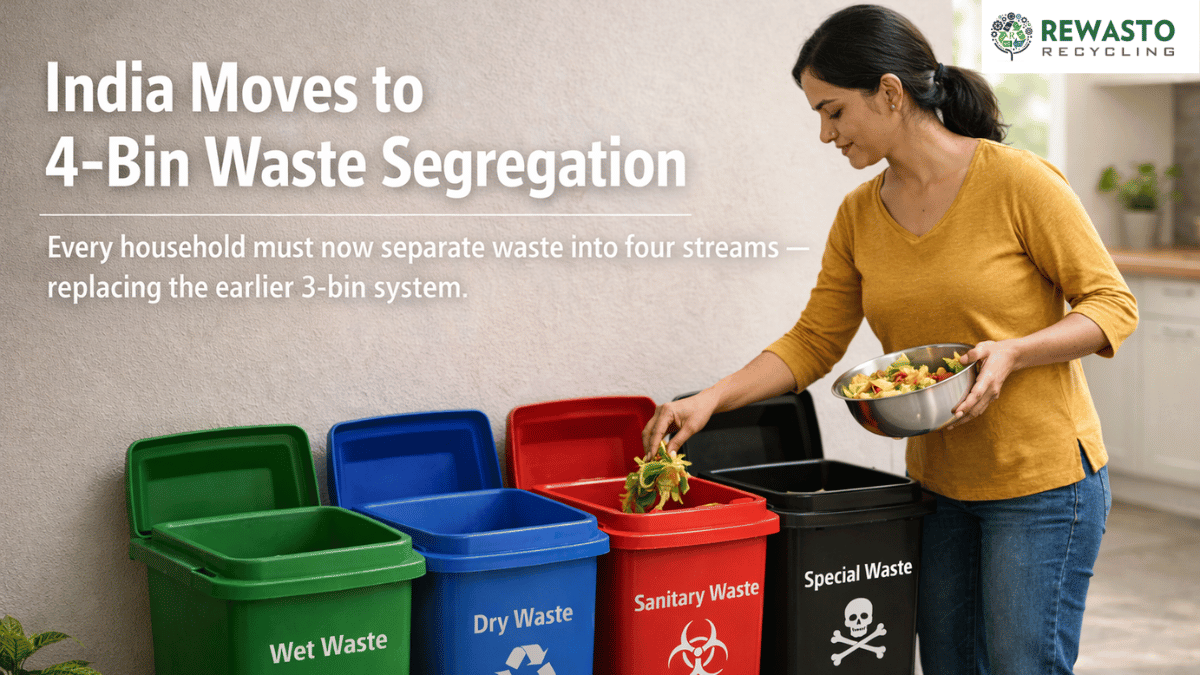
The SWM Rules 2026, notified January 28, 2026 by MoEFCC and in force from April 1, 2026, replace a decade-old framework with mandatory four-stream segregation and digital waste tracking.
Why India Needed a Complete Waste Overhaul
India generates approximately 1.85 lakh tonnes of solid waste every single day. Of this, only 60 to 70 percent is collected, and barely 15 to 20 percent is properly processed. The rest accumulates in landfills and open dumpsites — a crisis that had been building silently for a decade while the Solid Waste Management Rules of 2016 struggled under weak enforcement, poor accountability, and an infrastructure deficit that most Urban Local Bodies were simply not equipped to bridge.
The MoEFCC issued its response on January 28, 2026: a complete regulatory reset in the form of the Solid Waste Management Rules, 2026, which came into full force on April 1, 2026, superseding the 2016 framework entirely. The rules are grounded in the Environment (Protection) Act, 1986 and implement the “Polluter Pays” principle with enforceable financial consequences for the first time.
In Bhopal Municipal Corporation v. Dr Subhash C. Pandey, the Supreme Court framed solid waste management as inseparable from Article 21 — the Right to Life. The Court classified urban waste management as a constitutional obligation, mandating sworn affidavits of infrastructure readiness from all local authorities before April 1.
The Core Change: Four-Stream Segregation
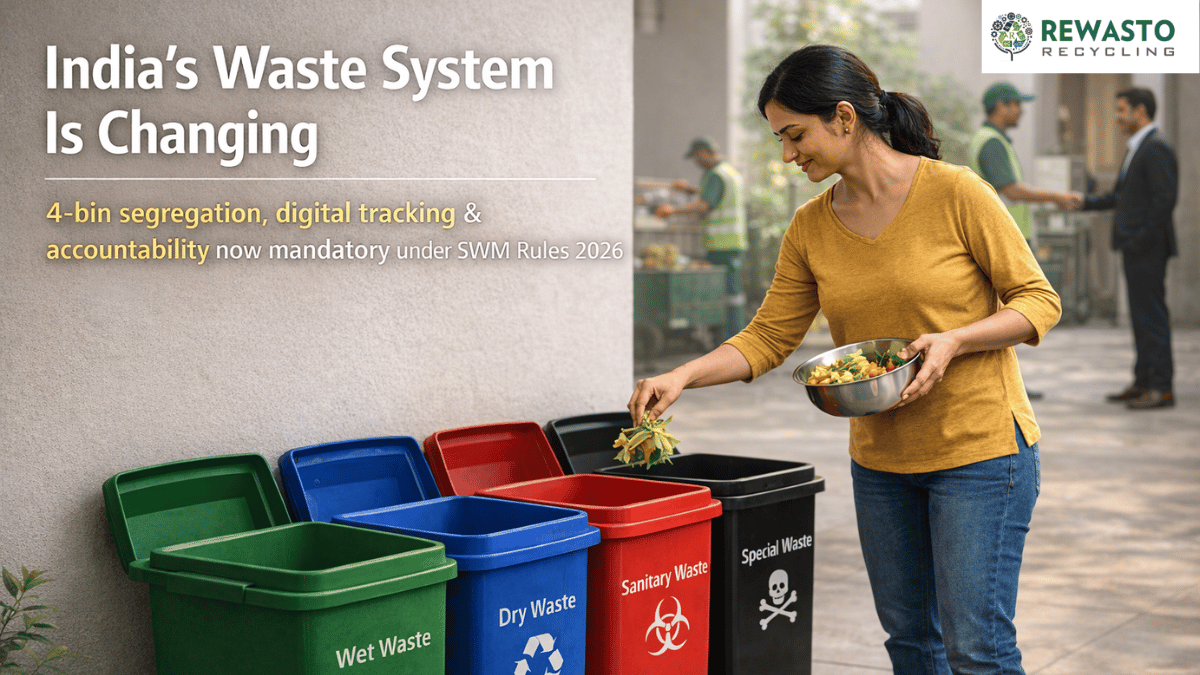
The most immediate, visible change for every Indian household and institution is the shift from three bins to four. Every waste generator is now legally required to sort waste before handover to collectors.
Municipal bodies are legally required to modify collection vehicles with four distinct compartments. Sanitation workers are now empowered by law to refuse collection of unsegregated waste.
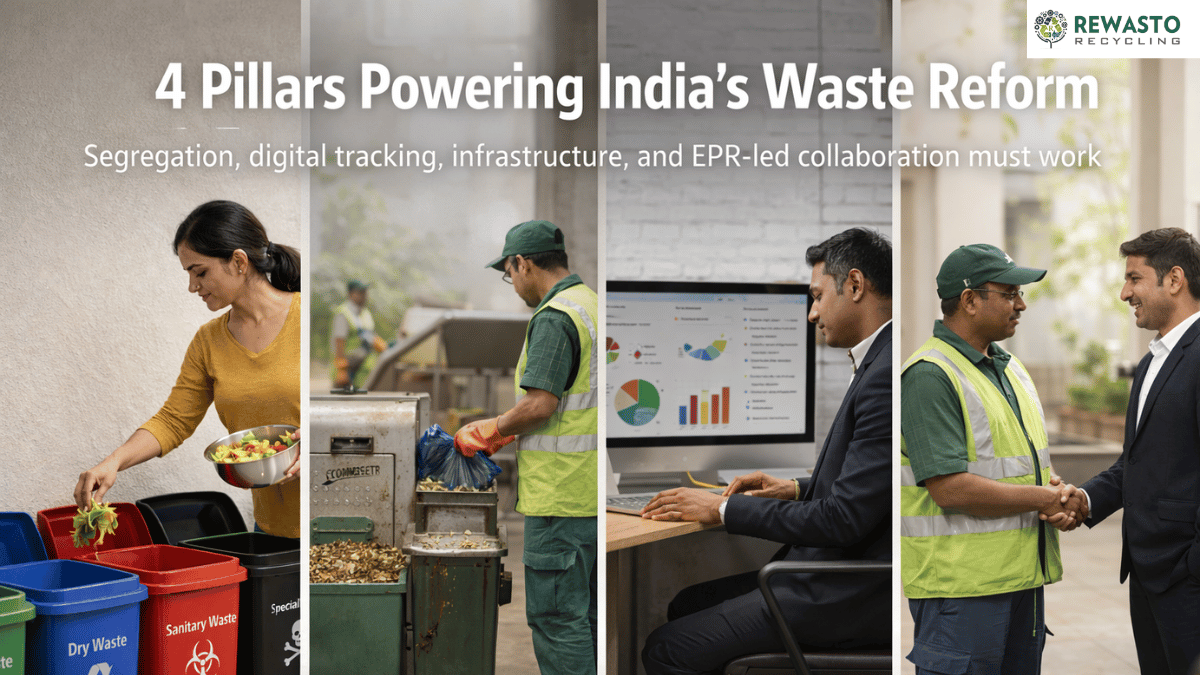
Every Indian household must now maintain four separate, color-coded bins — a shift from the previous three-bin system under SWM Rules 2016.
2016 vs. 2026: What Actually Changed
The SWM Rules 2026 are not an amendment — they are a complete replacement of the 2016 framework.
| Feature | SWM 2016 | SWM 2026 |
|---|---|---|
| Segregation streams | 3 — wet, dry, hazardous | 4 — wet, dry, sanitary, special care |
| BWG threshold | Not clearly defined | 100 kg/day, 20,000 m², or 40,000 L/day |
| Penalty mechanism | Weak, poorly enforced | Polluter Pays — Environmental Compensation levied |
| Digital monitoring | None | Centralized CPCB portal — full lifecycle tracking |
| Landfill restrictions | Broadly permitted | Restricted to inert, non-recyclable waste only |
| RDF substitution | Optional / limited | Mandatory ramp-up: 5% → 15% over six years |
| EPR framework | Conceptual only | Operational with measurable penalties |
| Vehicle norms | General guidance | Four-compartment vehicles mandated |
| Worker rights | Not addressed | Empowered to refuse unsegregated waste |
| Carbon credits | Not addressed | Explicitly encouraged for local bodies |
Who Must Comply and to What Degree
The short answer is everyone — but the degree of obligation varies significantly by category.
- Segregate waste into four streams before handing to sanitation workers
- Wrap sanitary waste securely before disposal
- Store horticulture and C&D waste separately
- Never burn or dump waste in open areas
- Pay user fees as notified by local bodies
- Generate 100 kg or more of solid waste per day
- Have a total built-up area of 20,000 m² or more
- Consume 40,000 litres of water per day or more
- Maintain four-stream segregation internally
- Comply with door-to-door collection norms
- Register if meeting BWG thresholds
- Never mix biomedical or electronic waste into general streams
- Plan waste management into the event budget
- Provide clearly labelled four-stream bins throughout the venue
- Brief all staff and volunteers before the event
- Ensure post-event waste is disposed through registered channels
- Operate within the strengthened EPR framework
- Comply with product lifecycle waste obligations
- Maintain separate EPR registrations for plastic, e-waste, batteries, and tyres
- Provide door-to-door collection with four-compartment vehicles
- Coordinate and manage Material Recovery Facilities
- Maintain centralized CPCB portal data
- Large cities: compliance within 18–24 months; smaller towns: 36 months
Bulk Waste Generator Compliance: Step by Step
For large residential societies, commercial complexes, hospitals, and institutional buildings that qualify as BWGs, the compliance path is structured.
BWG Compliance Checklist
Track your organization’s readiness under SWM Rules 2026. Tap each item as you complete it.
- Assess whether your entity meets BWG criteria (100 kg/day, 20,000 m², or 40,000 L/day)
- Register on the CPCB centralized portal via your local ULB
- Set up or contract on-site wet waste processing (composting / bio-methanation)
- Install four color-coded bins across all premises and common areas
- Train staff, housekeeping, and residents on the four-stream system
- Establish internal collection schedules aligned to local ULB timings
- Obtain your EBWGR Certificate from the CPCB portal
- Set up a waste quantity tracking and record-keeping system
- Appoint a dedicated Waste Management Officer internally
- Review and update BRSR disclosures (for listed companies)
- File periodic compliance reports through the CPCB portal
Penalties: The Polluter Pays Principle in Action
For the first time, non-compliance is designed to cost more than compliance. Landfill fees for unsegregated mixed waste are set higher than the combined cost of proper segregation, transport, and processing.
| Violation | Consequence | Severity |
|---|---|---|
| Failure to segregate waste at source | Monetary fine; collection refused | Medium |
| Operating as BWG without CPCB registration | Environmental Compensation levied | High |
| False reporting or forged documents | Compensation + registration suspension | High |
| Improper solid waste management | Environmental Compensation under Polluter Pays | High |
| Unsegregated waste sent to landfill | Higher landfill user fees | Medium |
| Repeat violations by individuals | Escalating fines and enforcement | High |
| Violations under Rule 19 / Env. Act | Up to Rs. 15 lakh or daily penalties | Critical |
For listed companies qualifying as BWGs, the stakes extend beyond regulatory penalties. SEBI’s BRSR requirements mean waste non-compliance carries financial-market consequences. CPCB will publish quarterly defaulter lists on its public portal.
The Digital Backbone: CPCB’s Centralized Portal
A centralized online portal now tracks the entire lifecycle of solid waste — from generation through collection, transport, processing, and final disposal.
Key Dates and Milestones
The full chronology from the origins of this reform to the targets ahead.
The bins are now four. The question is whether all four will actually be used — and collected. India has a history of well-designed rules meeting poorly equipped implementation.
Your Action Guide: What to Do Right Now
Every category of entity — household, business, institution, or event organizer — has a concrete set of actions to take immediately.
Successful implementation requires four pillars: citizen segregation, digital reporting, infrastructure expansion, and public-private coordination through EPR-driven investment.
Implementation Challenges: What Experts Caution
The SWM Rules 2026 are broadly welcomed by environmental experts — but nearly all caution that well-intentioned rules cannot overcome a decade of infrastructure deficits and institutional inertia on their own.
The Implementation Gap
Many cities face shortages in collection vehicles, trained personnel, and processing capacity. The rules place compliance obligations on waste generators, but do not specify what happens when a ULB collects mixed waste due to its own infrastructural limitations.
Delhi as a Case Study
Delhi’s three landfills — Bhalaswa, Ghazipur, and Okhla — are among the tallest man-made structures in the capital, growing for decades because waste was never properly segregated at source.
What Needs to Work for the Rules to Succeed
- Source segregation adopted consistently across all income levels and geographies
- Digital reporting by all producers, processors, and recyclers on the CPCB portal
- Expansion of Material Recovery Facilities, composting units, and recycling parks
- Public-private coordination through EPR-driven infrastructure investment
- Integration of informal waste pickers into formal, recognized systems
- Stronger financial support from the Centre to ULBs in smaller cities
- Sustained public awareness campaigns — especially in tier-2 and tier-3 cities
Official notification: moef.gov.in · CPCB compliance portal: cpcb.nic.in · Swachh Bharat Mission: swachhbharatmission.gov.in
How Rewasto Can Help You Comply
End-to-end SWM 2026 and EPR compliance support — for housing societies, businesses, institutions, and brand owners across India.