Rewasto Recycling

EPR Producer Registration in India: Complete Step-by-Step Guide (2025–26) | Rewasto
Rewasto Β· Environmental Compliance Guide Β· 2025–26

EPR Producer
Registration
in India

The definitive guide for manufacturers, importers, and brand owners navigating CPCB’s EPR portals across e-waste, plastic packaging, batteries, and waste tyres.
⚑ E-Waste ♻️ Plastic πŸ”‹ Batteries βš™οΈ Tyres πŸ“‹ CPCB Compliance
By Rewasto Experts 11-Step Process 18 min read April 2026
0
Waste Streams Covered
0
Registration Steps
0
Years Battery Validity
0
Days Before Renewal Deadline
EPR Producer Registration India Overview
IMAGE PLACEHOLDER β€” 16:9 Ratio Suggested: CPCB compliance overview / waste management / circular economy visual

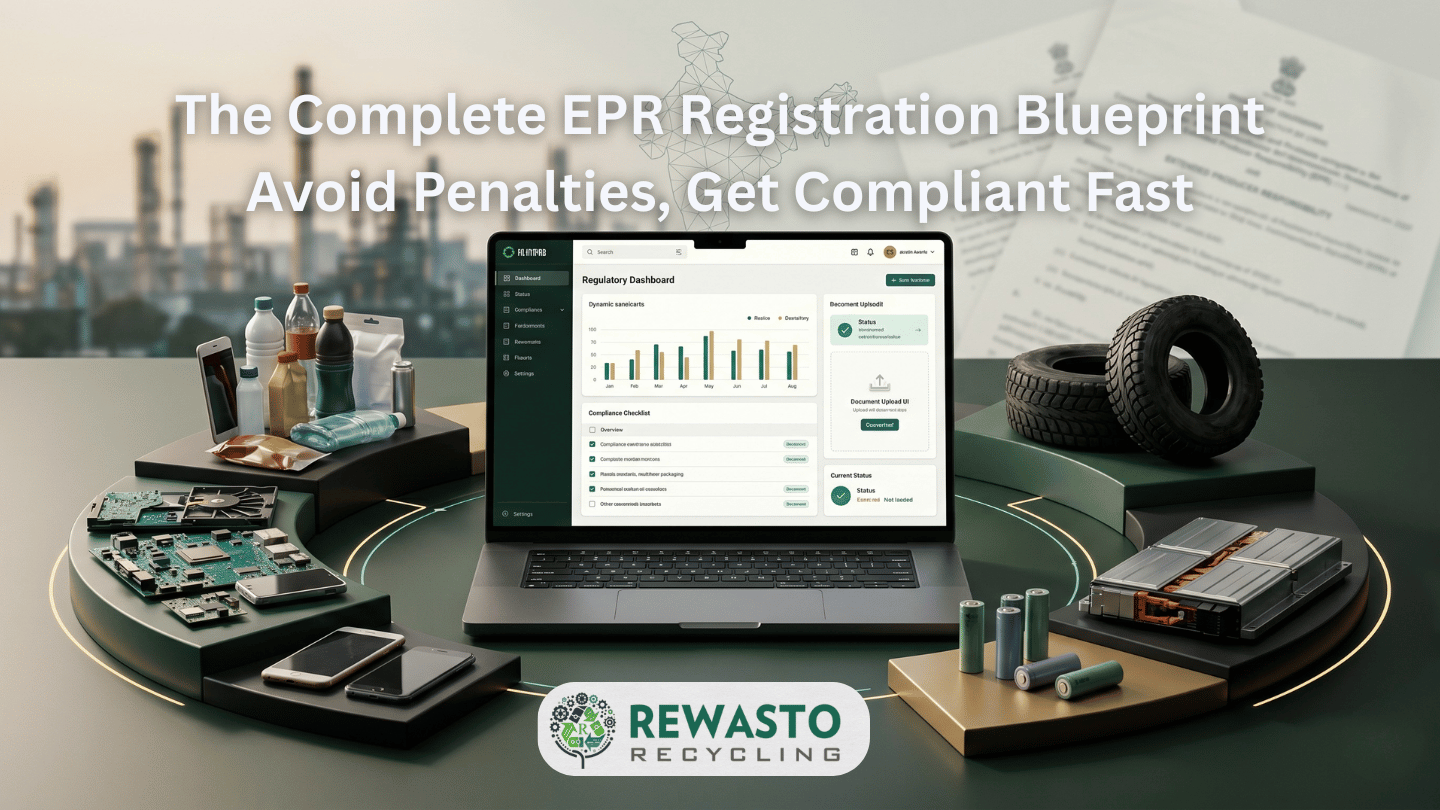
India’s EPR framework covers four major waste streams through CPCB’s dedicated portals under the Environment (Protection) Act, 1986.

πŸ”‘ Topics EPR Registration IndiaCPCB Portal PIBO ComplianceE-Waste Rules Plastic EPRBattery Producer Responsibility Environmental Compensation

What Is EPR and Why Does It Matter?

Extended Producer Responsibility (EPR) is a legal framework under which manufacturers, importers, and brand owners are held accountable for the environmentally responsible management of their products after those products reach the end of their useful life. If you place a product into the Indian market, you are legally responsible for ensuring the waste it generates is properly collected, recycled, or processed.

In India, EPR is governed by rules notified under the Environment (Protection) Act, 1986. The Central Pollution Control Board (CPCB), under the Ministry of Environment, Forest and Climate Change (MoEFCC), operates dedicated online portals for four major waste streams.

⚑
E-Waste
eprewastecpcb.in
Electrical & Electronic Equipment β€” from smartphones to industrial machinery.
♻️
Plastic Packaging
eprplastic.cpcb.gov.in
All primary, secondary, and tertiary plastic packaging placed in the Indian market.
πŸ”‹
Batteries
eprbattery.cpcb.gov.in
All battery types β€” from EV packs to consumer cells and industrial batteries.
βš™οΈ
Waste Tyres
eprtyres.cpcb.gov.in
New tyre manufacturers, importers of tyres, and importers of waste tyres.
⚠️ Legal Mandate

Non-compliance with EPR obligations can result in heavy environmental compensation fines, suspension of business licenses, and in repeat cases, criminal liability under the Environment (Protection) Act. EPR registration is not optional.
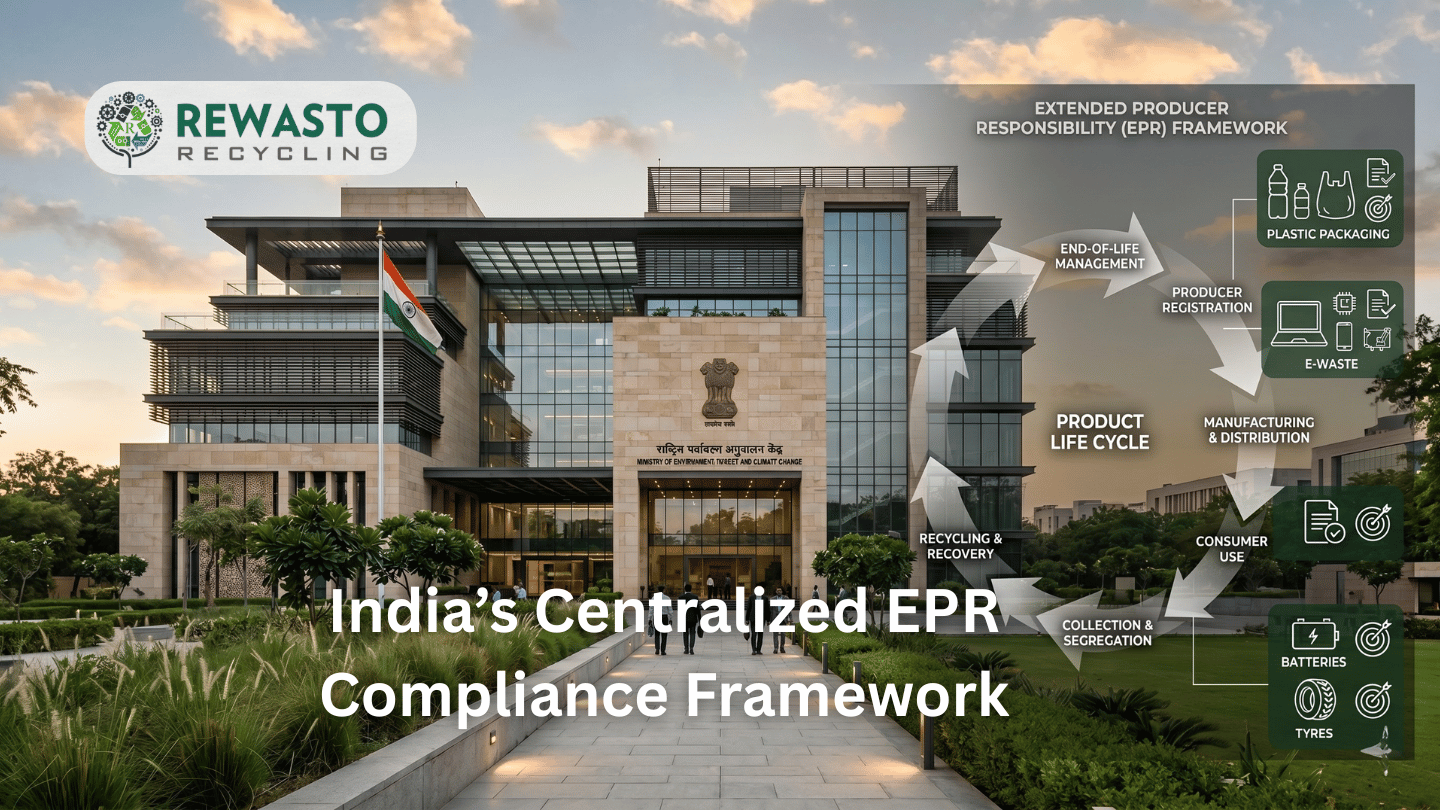
India’s EPR framework is administered by CPCB under the Ministry of Environment, Forest and Climate Change.

India’s EPR framework is administered by CPCB under the Ministry of Environment, Forest and Climate Change.

Who Needs to Register? Understanding PIBOs

EPR rules apply to entities classified as Producers, Importers, or Brand Owners β€” collectively known as PIBOs. Here is a comprehensive breakdown of who qualifies under each stream.

You are an E-Waste Producer if you:
  • Manufacture and sell electrical or electronic equipment under your own brand
  • Sell assembled EEE made by a contract manufacturer under your brand
  • Import any electrical or electronic equipment into India
Applicable: Schedule I (list of EEE), Schedule II (recycling targets)
You are covered under Plastic Waste Management Rules if you:
  • Manufacture plastic packaging in India
  • Import goods into India with plastic packaging and hold an IEC code
  • Sell any product under a registered brand that uses plastic packaging
Applicable: Schedule III (packaging category for EPR)
You are a Battery Producer if you:
  • Manufacture and sell batteries under your own brand
  • Import batteries or equipment containing batteries
  • Sell batteries produced by others under your brand label
Applicable: Schedule I, III (minimum recycling), Schedule IV (material recovery)
You are a Tyre Producer if you:
  • Manufacture and sell new tyres in India
  • Import tyres or vehicles fitted with tyres
  • Import waste tyres for processing
Note: An EV manufacturer may need registration across all four streams simultaneously.
πŸ’‘ Key Insight

A single company often needs to register across multiple streams. A smartphone brand, for example, typically requires registration under three streams simultaneously β€” e-waste for the device, batteries for the embedded cells, and plastic for the packaging.

11-Step EPR Registration Process

Although each waste stream has its own portal and forms, the overall registration process follows a consistent workflow. Follow these 11 steps for a complete, error-free registration.
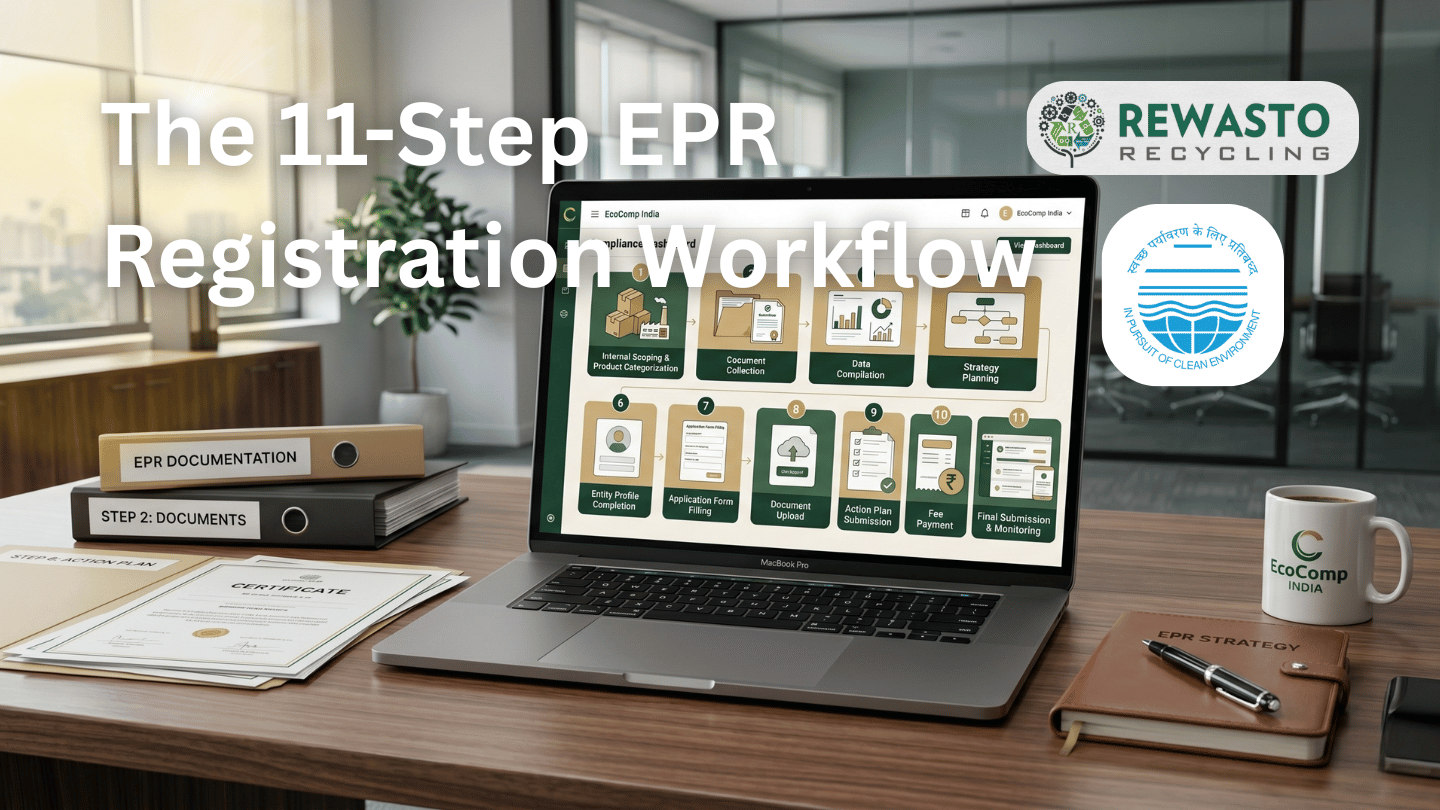
The EPR registration process spans 11 structured steps β€” from internal scoping to final submission and portal monitoring

The EPR registration process spans 11 structured steps β€” from internal scoping to final submission and portal monitoring.

1
Pre-Work
Internal Scoping & Product Categorization
List all products you manufacture, import, or sell. Map each against applicable waste categories (Schedules I–IV). Determine your role β€” Producer, Importer, or Brand Owner β€” for each stream. This step prevents the most common mistake: incomplete registration before you begin.
2
Documentation
Gather Your Corporate Documents
Prepare: Certificate of Incorporation / LLP Registration, Company PAN Card, GST Registration Certificate, CIN or LLPIN, IEC Code (importers), Registered Office Address Proof, Authorized Signatory PAN + Aadhaar + Board Resolution, and latest audited financial statements or GSTR-9.
3
Data
Compile Product and Sales Data
Gather historical sales and production data for the last 3 years, broken down by product category and year. Include quantities in tonnes or units, material composition details for batteries and tyres, and projections for upcoming years if requested. Involve sales, finance, and product engineering teams.
4
Strategy
Develop Your EPR Action Plan
CPCB requires a documented strategy. Your EPR Action Plan should outline which registered recyclers or PWPs you’ll partner with, how you’ll source EPR certificates, whether you’ll use a PRO or manage recycler tie-ups directly, any consumer take-back programs, and your internal data management process.
5
Portal
Create Your Portal Account
Head to the relevant CPCB portal and register your account. Fill in legal name, trade name, email, mobile, address, state, and PAN. Verify via OTP. Store credentials securely β€” you’ll need them for all future returns, renewals, and EPR certificate transactions.
6
Profile
Complete Your Entity Profile
Complete the master entity profile before starting your formal application β€” legal entity details (CIN, GST, IEC), manufacturing facility locations and existing SPCB consents (CTE or CTO), authorized signatory and primary contact information.
7
Application
Fill the Application Form (Form 1 / Form 1A)
Part A β€” company details and addresses; Part B β€” product categories, quantities, material composition; Part C β€” EPR strategy; Part D β€” compliance declarations. Take extra time with Part B β€” this is where most application errors occur.
8
Upload
Upload Supporting Documents
Stream-specific extras: E-Waste β€” EEE product codes, covering letter; Plastic β€” packaging categorization sheet, waste generation calculations; Batteries β€” Form 1(A) & 1(C), battery category table, SPCB consents; Tyres β€” composition annexure, CA certificates, GST annual returns.
9
Plan
Upload Your EPR Action Plan
Submit the EPR Action Plan as a separate document. Follow the portal-provided template precisely β€” deviating from the template is one of the most common reasons for deficiency notices. Ensure the plan aligns with the product quantities declared in your application form.
10
Fee
Pay the Registration Fee
Registration fees are non-refundable and slab-based (volume of waste generated). For plastic PIBOs, fees vary by tonnes per annum. For e-waste, batteries, and tyres, fees are prescribed in the respective SOPs and payable directly through the portal. Retain the payment receipt.
11
Final
Submit and Track Your Application
Review the portal checklist before submission. Submit electronically β€” the portal generates a reference number and shows real-time status on your dashboard. Log in every 2 weeks to check for deficiency notices. CPCB communicates all queries through the portal only β€” not by email or phone.
πŸ“Œ Critical Pro Tip

Log into the portal at least once every two weeks after submission. CPCB communicates all deficiency notices through the portal dashboard only β€” not by email or phone. Missing a notice can cause your application to lapse without warning.

Complete Documents Checklist

Click each item to track your preparation progress. Having all documents ready before starting the portal application prevents costly mid-process delays and deficiency queries.

  • Certificate of Incorporation or LLP Registration
  • Company PAN Card
  • GST Registration Certificate
  • Corporate Identification Number (CIN) or LLPIN
  • Importer Exporter Code (IEC) β€” if applicable
  • Registered Office Address Proof
  • Authorized Signatory PAN and Aadhaar
  • Board Resolution or Authorization Letter
  • Latest Audited Financial Statements or GSTR-9 Annual Return
  • Sales data for last 3 years, broken down by product category
  • EPR Action Plan document (per CPCB template)
  • Stream-specific annexures β€” EEE codes / battery composition / tyre annexure
  • SPCB Consent to Establish (CTE) or Consent to Operate (CTO) for manufacturing units
0 / 13 ready
Preparing all documents in advance prevents mid-application delays and deficiency notices from the CPCB portal

Preparing all documents in advance prevents mid-application delays and deficiency notices from the CPCB portal.

What Happens After Registration?

Receiving your EPR Registration Certificate is not the end β€” it is the beginning of ongoing annual compliance obligations. Here is what you need to manage every year.

Meeting Annual EPR Targets

Your certificate specifies annual recycling, collection, or processing targets tied to your sales volumes. These targets escalate year-on-year. You fulfill them by purchasing EPR certificates from CPCB-registered recyclers through the portals.

Record-Keeping

Maintain detailed records of all products placed on the market, all EPR certificates purchased, and all recycler agreements and invoices. Retain all underlying documents for 5–7 years in line with typical audit periods under the rules.

Periodic Return Filing

  • E-Waste producers: Quarterly and annual returns
  • Plastic PIBOs: Annual returns by CPCB’s notified deadline
  • Battery producers: Periodic returns on batteries placed in market and EPR certificates used
  • Waste tyre producers: Annual returns detailing production, imports, and obligations met

Registration Renewal

Battery registrations are valid for 5 years. Battery SOPs require renewal applications at least 60 days before expiry. Renewal requires all due returns filed and no major non-compliance outstanding.

Environmental compliance is not a one-time event β€” it is a continuous business function that demands the same rigour as financial reporting.

5 Common EPR Mistakes to Avoid
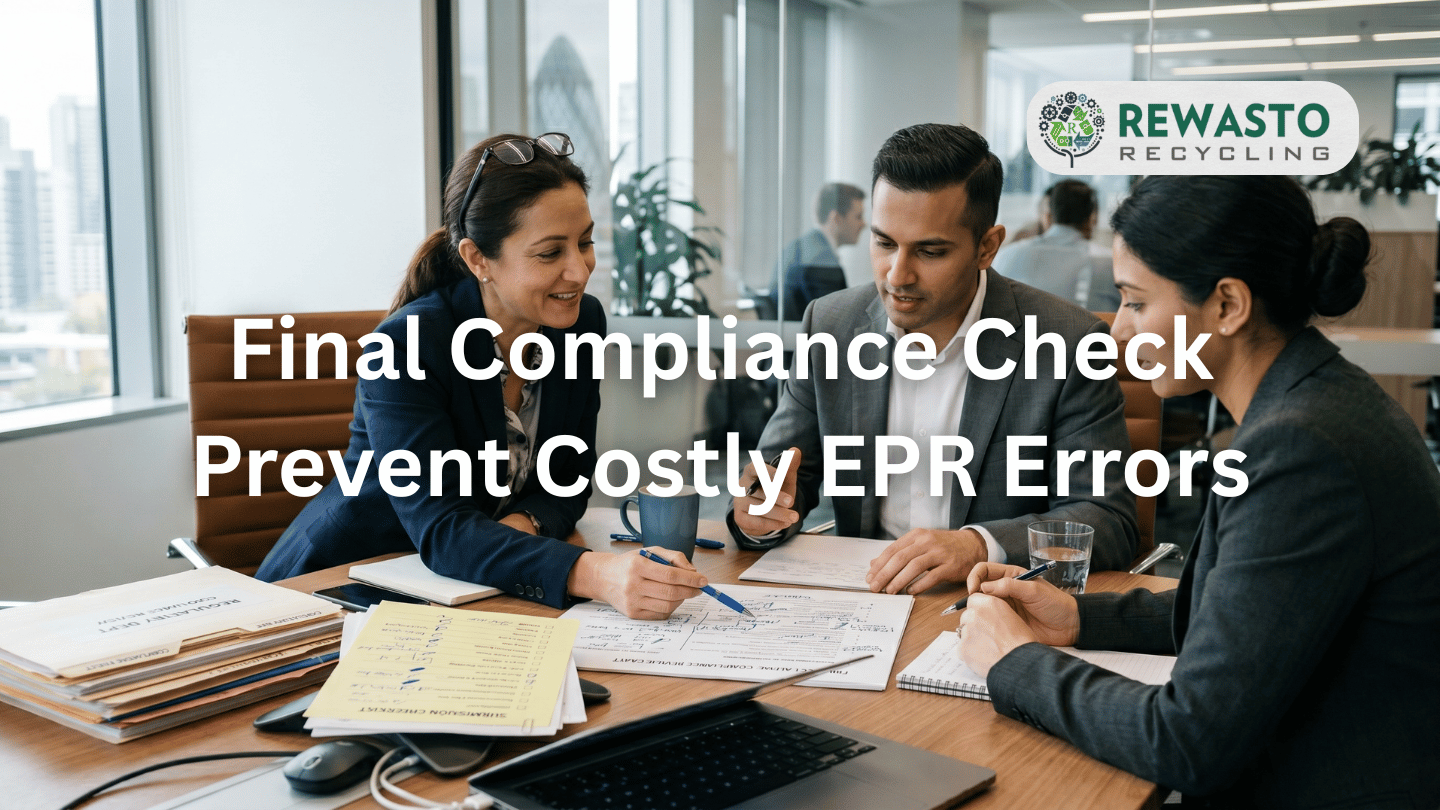
Avoiding these five common errors can save your company from costly penalties, re-filings, and enforcement action
l

Avoiding these five common errors can save your company from costly penalties, re-filings, and enforcement action.

Many companies misclassify plastic packaging or under-declare the weight of packaging or batteries β€” leading to understated EPR obligations flagged during CPCB audits. Fix: Involve packaging engineering and product design teams. Build a Bill of Materials-based weight estimation model before the application.
Companies often obtain plastic EPR registration while overlooking e-waste or battery obligations for the same products. A smartphone brand typically needs registration under three streams simultaneously. Fix: Conduct a thorough cross-stream scoping exercise at the outset.
Purchasing EPR certificates from recyclers who later lose their authorization can result in CPCB disallowing those credits β€” forcing you to re-fulfill the obligation. Fix: Always verify recycler registrations directly on the CPCB portal before transacting. Retain copies of their SPCB consents.
Applications frequently lapse because applicants don’t monitor the portal post-submission. CPCB issues all deficiency notices through the portal dashboard β€” not by email or phone. Fix: Establish an internal compliance calendar and schedule fortnightly portal reviews.
Even with external consultants engaged, the legal responsibility for EPR compliance remains entirely with your company. Fix: Internal teams must understand the obligations, verify submitted data, and review all filings before final submission.

Penalties for Non-Compliance

The consequences of failing to register or meet EPR obligations are serious β€” and enforcement has intensified significantly as CPCB actively tracks portal data and cross-checks against GST filings.

ViolationConsequenceSeverity
Failure to register on CPCB portalEnvironmental Compensation + business disruptionHigh
Missing annual EPR recycling targetsEnvironmental Compensation tied to shortfall quantityHigh
Late or non-filing of periodic returnsFines and complications at renewal timeMedium
Section 15 fines β€” Environment (Protection) Act, 1986Up to β‚Ή1 lakh per day of violationHigh
Repeat non-compliance offencesCriminal prosecution, potential imprisonmentCritical
Suspension / cancellation of EPR registrationCannot place covered products in the Indian marketCritical
CPCB's enforcement has intensified with automated cross-referencing of EPR portal data against GST filings and sales records.

CPCB’s enforcement has intensified with automated cross-referencing of EPR portal data against GST filings and sales records.

⚠️ Enforcement Trend

The risk of enforcement has increased significantly in recent years as CPCB has become more active in tracking portal data and auditing returns. Do not treat EPR as a one-time administrative formality.

Your Compliance Partner

How Rewasto Can Help You

End-to-end EPR compliance across all four CPCB portals β€” for Indian companies of all sizes.

πŸ”
Applicability Assessment
We evaluate whether your company needs to register and across which streams, before you spend a single hour on the portal.
πŸ“‹
Complete Registration
End-to-end application support for e-waste, plastic packaging, battery, and tyre EPR registrations on CPCB portals.
πŸ“
EPR Action Plan
We draft your action plan to align with CPCB expectations and your specific business operations.
♻️
Recycler Network
We help identify and transact with verified, CPCB-registered recyclers for EPR certificate procurement.
πŸ“…
Annual Return Filing
We manage your periodic compliance filings so you never miss a CPCB deadline or incur late fees.
πŸ”„
Renewal Management
We track your registration validity dates and ensure timely renewal β€” well before the expiry deadline.
Get in touch β†’ 🌐 rewasto.in
βœ‰οΈ recycle@rewasto.in EPR Registration Β· Annual Returns Β· EPR Credits Β· Compliance Advisory

This guide is published by Rewasto, a government-registered recycler, for informational purposes only. For the most current regulatory requirements, always refer to official CPCB portals and notifications. Β© 2024 Rewasto Β· rewasto.in Β· recycle@rewasto.in