India’s Recycling Stocks Are Quietly Printing Money
India’s Recycling Stocks Are Quietly Printing Money — Here’s How to Invest | Rewasto
Rewasto · Market Deep Dive · May 2026
India’s Recycling
Stocks Are Quietly Printing Money
From e-waste generating over 14 lakh metric tonnes a year to a circular economy market
projected at $1.34 billion by 2030 — here is the investor’s complete guide to India’s green gold rush,
and why EPR regulations are the engine behind every rally.
Why Recycling Stocks Are India’s Most Underrated Bet Right Now
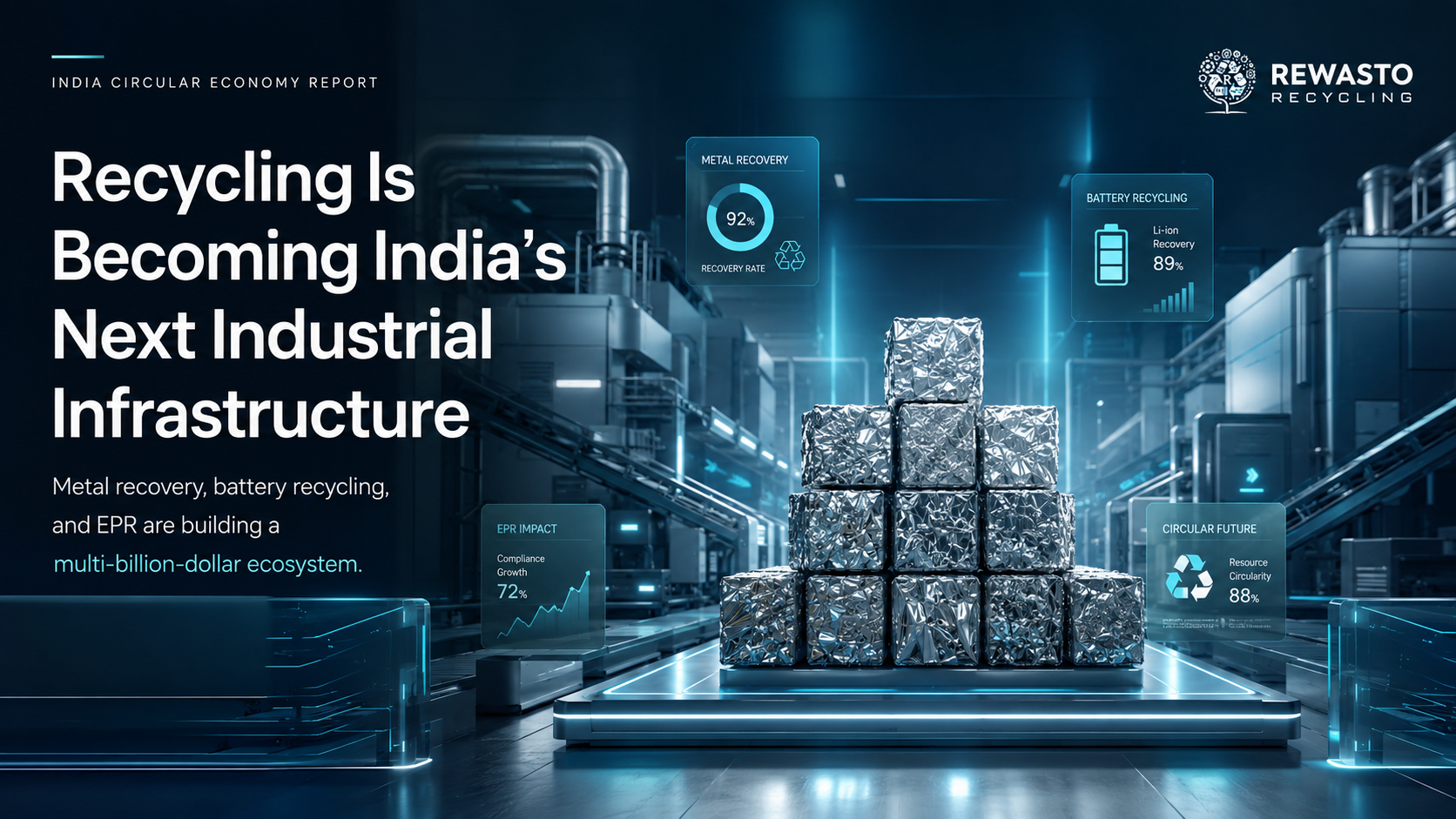
India is sitting on a mountain of discarded electronics, dead batteries, and plastic waste — and a handful of listed companies are quietly converting that waste into serious shareholder returns. The government’s mandatory Extended Producer Responsibility framework, a freshly approved Rs 1,500 crore incentive scheme for critical mineral recycling, and customs duty exemptions on lithium-ion battery scrap have collectively de-risked the long-term investment thesis in a way few other sectors can claim.
From EV batteries to smartphones to industrial scrap, every tonne that enters the formal recycling chain means revenue for India’s listed recyclers. The Union Budget 2025-26 added further tailwinds, making this one of the rare sectors where regulation actively creates demand rather than constraining it.
India generates over 60 million tonnes of municipal solid waste annually, with e-waste alone growing at roughly 20% per year — making it one of the fastest-expanding waste streams on the planet. NITI Aayog values the annual e-waste stream at over Rs 51,000 crore. The organised sector captures only a fraction of that today. The companies that build the infrastructure to capture more of it will compound significantly over the next decade.
📊 Market Projection
India’s recycling market stood at $0.89 billion in 2025 and is projected to reach $1.34 billion by 2030 at an 8.5% CAGR — driven by EPR mandates, EV battery recycling, and critical mineral recovery policies.
Key Recycling Stocks on BSE/NSE — Snapshot
The Indian recycling space spans metal recyclers, municipal waste operators, pure-play e-waste firms, and plastic processors. Each sub-segment has its own risk-return profile. Here is a curated overview of the stocks worth watching.
🏗️
Gravita India
Revenue ₹1,173 Cr Q4 FY26 · +13.1%
India’s largest metal recycler. Lead, aluminium, plastic at industrial scale. Vision 2029: 700,000 MTPA capacity. Low D/E of 0.12.
🗑️
Eco Recycling
Revenue ₹5.91 Cr Q3 · -40% YoY
India’s first listed e-waste specialist. High margin model. Recent dip reflects short-term volatility — not structural weakness.
🌱
Antony Waste
Revenue ~₹200 Cr · +8% YoY
Municipal solid waste management with long-term city contracts. Steady, infrastructure-like revenue. Market cap ~Rs 3,578 Cr.
♻️
Ganesha Ecosphere
Growing · Positive Trend
India’s leading PET plastic recycler. Direct beneficiary of escalating plastic EPR targets. Strong institutional interest.
YoY Revenue Growth — Key Recycling Stocks (%)
Q3 FY2025-26 · Source: Company filings
Positive growthNegative growth
Gravita India — The Sector’s Crown Jewel
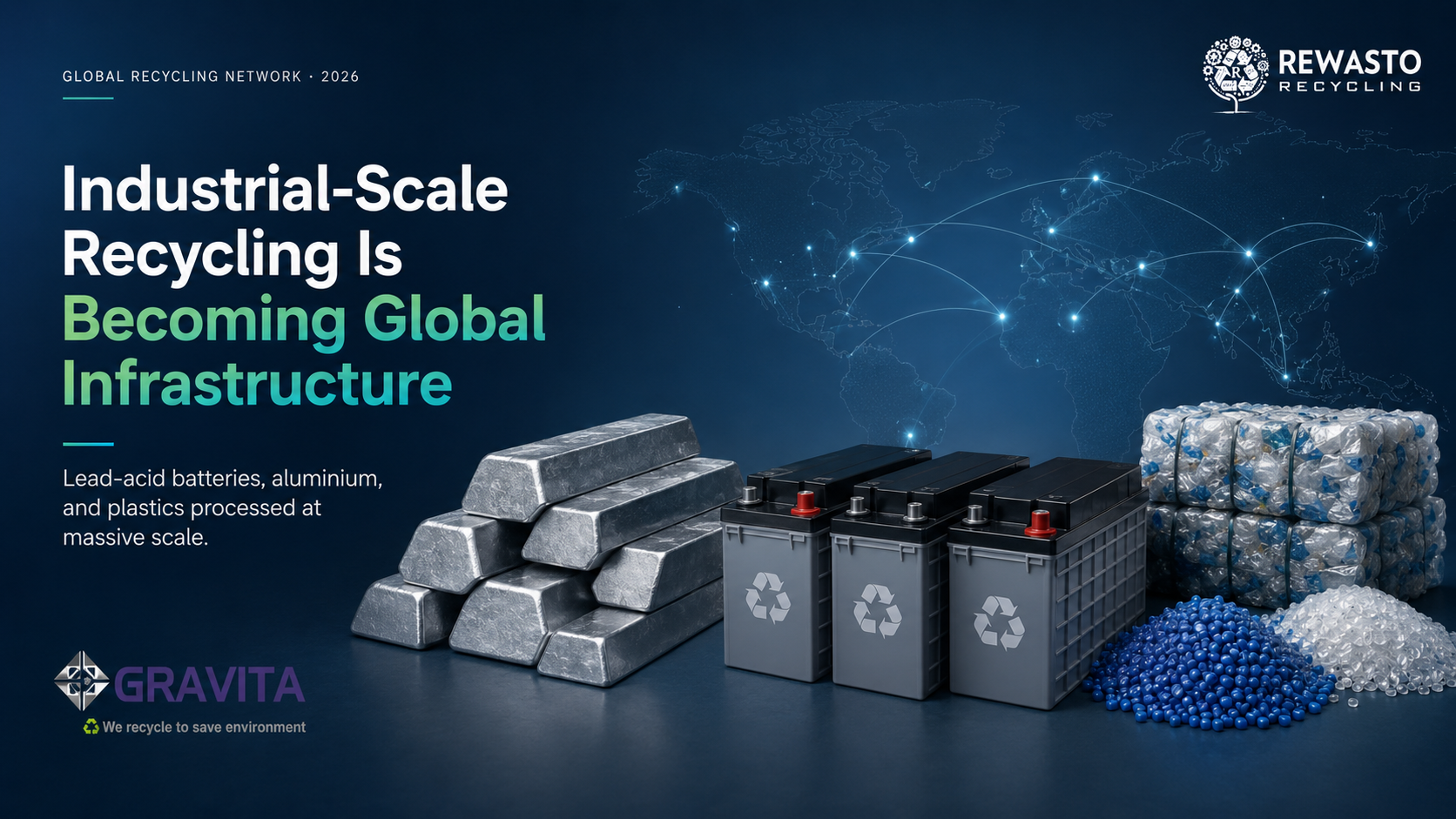
Gravita India operates 13 facilities across the world, recycling lead-acid batteries, aluminium, and plastics at industrial scale.
Founded in 1992 and headquartered in Jaipur, Gravita India is the undisputed anchor of the sector. In Q4 FY26, revenue climbed 13.1% to Rs 1,173 crore, while the 9-month FY26 period saw net profit rise 31% to Rs 286 crore. The company’s Vision 2029 plan targets a jump in capacity from 334,000 MTPA to over 700,000 MTPA by FY28, backed by a Rs 1,500 crore capital expenditure plan.
A brand new Rs 160 crore copper recycling plant is currently under construction in Gujarat — a strategic move into a high-value metal with surging EV-linked demand. With a debt-to-equity ratio of just 0.12, Gravita has the balance sheet strength to execute its expansion without dilution risk. For long-term investors seeking a proven, institutionally backed entry into the recycling theme, Gravita remains the default choice.
Gravita India — Quarterly Revenue vs Net Profit (₹ Cr)
8 quarters ending Q4 FY26 · Source: BSE filings
Revenue (₹ Cr)Net Profit (₹ Cr)
EPR: The Regulation That Is Minting Money for Recyclers
India’s Extended Producer Responsibility framework is the single biggest structural tailwind for the sector. Under EPR rules notified by the Ministry of Environment, Forest and Climate Change, manufacturers, importers, and brand owners must ensure their products are collected and recycled after use. The targets are not static — they escalate every year, and the penalties for falling short are severe.
Waste Category
FY 2024-25 Target
FY 2025-26 Target
FY 2027-28 Target
E-waste recycling
60%
70%
80%
Rigid plastic packaging
50%
60%
80%
Battery recovery (EV/Industrial)
70%
80%
90%
Flexible / multilayer packaging
30%
40%
60%
For investors, this means stock performance is no longer driven purely by scrap commodity prices. It is now anchored by regulatory compliance contracts, long-term collection network agreements, and EPR-linked volumes — creating a far more predictable and recurring revenue base. Companies that are CPCB-authorised recyclers benefit directly: every brand that needs to fulfill its EPR obligation must route waste through a registered recycler, creating steady demand that does not depend on economic cycles.
Recycling is no longer a commodity play — it is a regulatory infrastructure play, and the companies that get certified early will have the widest moats.
How the EPR Cascade Works — and Who Wins
Any company that manufactures, imports, or sells products with e-waste, plastic packaging, batteries, or tyres must register on CPCB’s dedicated EPR portals. They must declare annual sales volumes, meet escalating recycling targets, and file periodic compliance returns.
Registration on CPCB portals for each applicable waste stream
Annual EPR certificate procurement from registered recyclers
Quarterly and annual return filing — failure triggers environmental compensation fines
Non-compliance penalty: up to Rs 1 lakh per day under Section 15 of the Environment (Protection) Act, 1986.
CPCB-authorised recyclers are the essential link in the EPR chain. They receive waste from producers, process it through environmentally sound methods, and issue EPR certificates that brands use to fulfill their compliance obligations.
Mandatory, regulation-driven demand — not cyclical
Long-term processing agreements with brand partners
EPR certificate trading creates an additional revenue stream
This is why authorised recyclers like Rewasto, Eco Recycling, and Gravita’s recycling arms have structurally superior business models relative to pure commodity recyclers.
The recycling sector requires differentiated analysis across sub-segments:
Metal recyclers (Gravita, POCL): Commodity cycle exposure, capital-intensive, but scale advantages are durable
Pure-play e-waste firms: Higher volatility, but bigger upside as EPR enforcement tightens
Municipal waste operators (Antony Waste): Slower growth, but annuity-like cash flows from long-term city contracts
Watch for: CPCB audit outcomes, LME metal price cycles, EV battery availability, and government capex on waste infrastructure.
Market Growth Projection — 2025 to 2030
India Recycling Market Size Projection ($ Billion)
2025-2030 at 8.5% CAGR · Source: Sector research
Market Size ($ Bn)
The trajectory is clear: India’s recycling market will nearly double between 2025 and 2030. Three forces underpin this: the mandatory EPR regime creating baseline demand, the EV revolution generating unprecedented volumes of battery waste needing processing, and the government’s critical mineral recovery scheme incentivising investment in high-value recycling infrastructure. The question for investors is not whether this market grows — it is how much of the growth ends up in the listed ecosystem versus the informal sector.
Risks Investors Must Not Ignore
The recycling sector is not without turbulence. Eco Recycling’s stock hit a 52-week low in March 2026, down over 56% year-on-year, as Q3 net profit fell nearly 60%. Commodity price swings, dependence on scrap supply chains, and persistent competition from informal recyclers remain structural headwinds. Smaller pure-play firms are also exposed to regulatory changes that introduce compliance costs faster than they can be absorbed.
Risk Factor
Who Is Most Exposed
Severity
LME commodity price swings
Metal recyclers (Gravita, POCL, Baheti)
Medium
Informal sector competition
All players, especially small-caps
Medium
EPR compliance costs rising
Small-cap e-waste and plastic recyclers
Medium
CPCB de-authorization of recyclers
Brands dependent on EPR certificates from small recyclers
High
Scrap supply chain disruption
All recyclers across segments
Medium
EV battery recycling timeline delay
Battery-focused recyclers
High
✅ Key Watchlist Signal
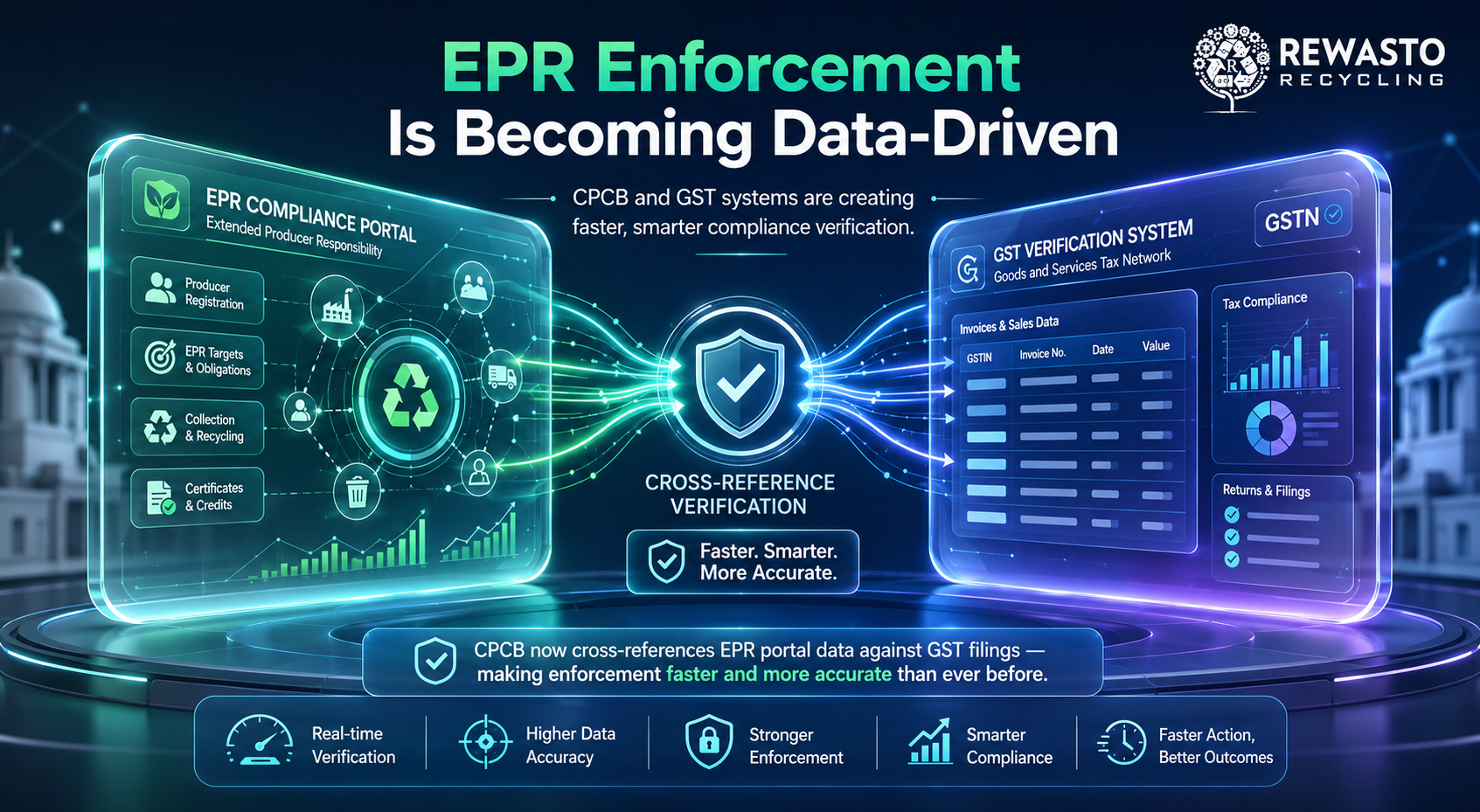
CPCB audit outcomes and GST cross-referencing of EPR portal data are the leading indicators to monitor. Companies with clean compliance records and diversified recycler networks are structurally better positioned for the next enforcement cycle.
CPCB now cross-references EPR portal data against GST filings — making enforcement faster and more accurate than ever before.
While giants like Gravita dominate headlines, a new generation of focused e-waste recyclers is building the infrastructure India needs. Rewasto is at the forefront.
🔋
E-Waste Recycling
End-to-end management for laptops, phones, servers, batteries, and general WEEE — safely and legally processed.
📋
EPR Compliance Partner
Brands and manufacturers use Rewasto’s CPCB-authorised volumes to fulfill their EPR recycling obligations and receive certificates.
🔒
Secure Data Destruction
Certified wiping and physical destruction of storage media to meet IT security and privacy norms — with full audit trails.
🚚
Reverse Logistics
Structured collection, transportation, and segregation of end-of-life electronics directly from corporate campuses.
🌍
ESG Reporting
Detailed traceability reports suitable for internal ESG disclosures and CPCB annual return submissions.
♻️
Urban Mining
Recovering precious metals from e-waste, reducing the flow of toxic materials into landfills and informal channels.